There are moments in television history that could never have been scripted because their magic comes from the unexpected. A host asks a simple question, an ordinary person takes a chance, and suddenly millions of viewers are witnessing something extraordinary.
That is the kind of story associated with Johnny Carson, the legendary host of The Tonight Show. For decades, Carson had an extraordinary ability to turn seemingly ordinary moments into unforgettable television. His relaxed personality, quick humor, and instinct for discovering talent made his show much more than a late-night talk program. For countless entertainers, appearing on Carson’s stage could become a life-changing opportunity.
One remarkable story begins with a surprisingly simple request.
Carson needed someone who could play the piano.
Rather than treating the situation as a problem, he turned to the audience and asked whether anyone knew how to play. It was the kind of spontaneous question that might normally produce a few nervous laughs and nothing more.
But then one audience member raised his hand.
That decision changed everything.
At first, the moment probably seemed amusing. The audience had no reason to expect that an unknown person sitting among them could suddenly become part of the show. People often volunteer for moments like these as a joke, especially when a famous television host is involved.
But Carson gave the man a chance.
The audience member was invited toward the piano, and suddenly the situation became very real. He was no longer simply watching the show. He was about to perform in front of a live studio audience and an enormous television audience at home.
There was no elaborate introduction.
No carefully planned entrance.
No opportunity to spend hours preparing backstage.
He simply had to sit down and play.
For most people, that would be terrifying.
The pressure of performing in front of Johnny Carson alone would have been enough to make many people reconsider their decision. Add the television cameras, the studio audience, and the possibility of millions of viewers watching, and the challenge became even greater.
But the man didn’t back away.
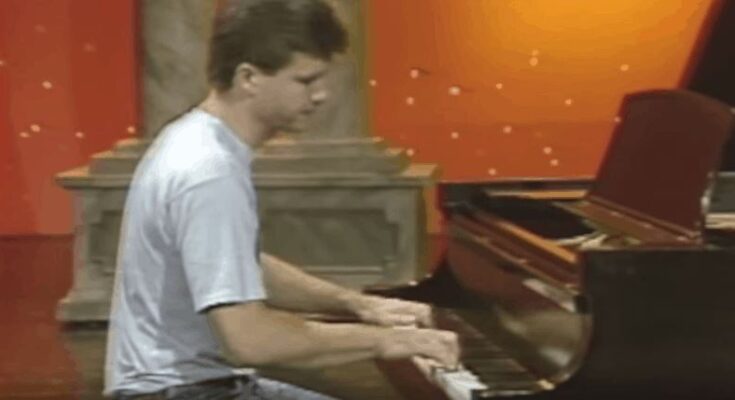
He sat down at the piano.
Then he began to play.
Almost immediately, the atmosphere changed.
The laughter and curiosity disappeared as the audience realized that the volunteer wasn’t simply someone who knew a few songs. He was a genuine musician.
His playing was confident, expressive, and polished. The notes flowed naturally, revealing the years of practice that must have taken place long before that unexpected television appearance.
Carson’s reaction was part of what made the moment so special.
The host had invited the man onto the stage because he was curious. Now he was watching the result with genuine appreciation. Carson had a reputation for recognizing performers who possessed something special, and the spontaneous piano performance gave him another opportunity to do exactly that.
The audience was equally impressed.
What began as a lighthearted interruption had turned into a serious musical performance.
Applause grew louder as the performance continued.
People who had never heard of the pianist moments earlier were now watching him with complete attention. The performer had transformed himself from an anonymous member of the audience into the center of the room.
And he had done it simply by being willing to raise his hand.
That is perhaps the most powerful part of the story.
The talent didn’t suddenly appear when the cameras turned on.
The ability had been there all along.
The television audience simply hadn’t known about it.
Years of practice, discipline, and dedication had prepared the musician for a moment he couldn’t possibly have predicted. When the opportunity arrived, he was ready.
This is an important distinction because people often describe successful moments as “lucky breaks.” Luck certainly played a role in placing the man in that audience at that particular time, but luck alone couldn’t have produced the performance.
Preparation made the opportunity meaningful.
Imagine if Carson had asked the same question and the man had never learned to play seriously. Raising his hand would have resulted in an awkward moment and perhaps a few laughs. Instead, his hidden skill turned an ordinary question into an unforgettable television experience.
The story also says something important about Johnny Carson himself.
Carson could have ignored the raised hand. He could have treated it as a joke and moved on to the next segment. Instead, he was willing to give an unknown person a chance.
That willingness was one of the qualities that made Carson such an influential figure in entertainment.
Throughout his career, The Tonight Show became a place where emerging performers could receive exposure that might otherwise have taken years to achieve. Comedians, musicians, actors, and other entertainers understood that a successful appearance on Carson’s program could dramatically increase their visibility.
Carson had an instinct for discovering people who could connect with an audience.
In this case, he didn’t even have to leave the studio to find someone interesting.
The talent was already sitting among the viewers.
The story is also a reminder that opportunities rarely arrive in the form we expect.
People imagine life-changing moments as major events that require months of preparation. Sometimes, however, the most important opportunities appear as ordinary questions.
“Can you play?”
“Would you like to try?”
“Do you want to come up here?”
The answer can change everything.
For the audience member who raised his hand, the decision could easily have gone the other way. He could have remained anonymous, watched the rest of the show, and gone home with nothing more than a memory of seeing Johnny Carson in person.
Instead, he took a risk.
He stepped forward.
He trusted his ability.
And he performed.
That courage is what makes the story resonate decades later.
It is easy to underestimate ourselves when an opportunity appears unexpectedly. Fear tells us to stay quiet. We worry about embarrassment, failure, or what other people might think.
But sometimes the greatest opportunities belong to the people willing to say yes before they know exactly what will happen.
Johnny Carson’s simple request created one of those moments.
A stranger raised his hand, walked onto the stage, and allowed millions of people to discover a talent that had previously been known only to those around him.
For a few minutes, the ordinary rules of television disappeared.
There was no carefully manufactured celebrity appearance.
There was simply a host, a piano, an unexpected volunteer, and an audience discovering something wonderful together.
That is why stories like this continue to fascinate fans of classic television.
They remind us that behind the polished productions and famous names were real people, spontaneous decisions, and moments that couldn’t be perfectly controlled.
Johnny Carson asked for a pianist.
One man answered.
And what happened next became a powerful example of how a little courage, combined with years of preparation, can turn an ordinary moment into something extraordinary.
Sometimes, history doesn’t begin with a grand announcement.
Sometimes, it begins with one person quietly raising a hand.